





Carbon Nanotubes
Back to In-Situ Electron Microscopy for Nanomaterial Synthesis
Contact: Federico PANCIERA
In collaboration with ILM Lyon, LPICM (École Polytechnique) and Thales, we study how single-wall carbon nanotubes (SWCNTs) grow and respond to strong electric fields. Using environmental transmission electron microscopy (ETEM), we observe these processes in real time, revealing how electric forces drive both growth mechanisms and mechanical failure at the atomic scale.
The experimental setup consists of two facing silicon cantilevers bridged by the CNTs: one is heated by Joule effect to enable growth, while the other is biased to control the applied field and polarity.
A major result of this work is the discovery of a clear polarity asymmetry. Under negative polarity, where field emission occurs, nanotubes shorten gradually from their apex as the electric field increases. Under positive polarity, where no field emission takes place, failure is much more abrupt: instead of a progressive evaporation of the tip, nanotubes are generally torn off directly from the catalyst. Only in rare cases—typically when the nanotube base is Y-shaped and mechanically stabilized—does gradual evaporation happen. This behavior confirms that field emission is the key mechanism driving tip evaporation under negative polarity.
Mechanical analysis further reveals that electrostatic stresses along the nanotube remain below the intrinsic strength of SWCNTs. Failure therefore occurs preferentially at the nanotube/catalyst or catalyst/substrate interfaces, rather than along the tube itself. The thinnest nanotubes are the most fragile, as they require higher surface fields; this explains the frequent observation of pull-out events and “nano-dart” geometries in the TEM.
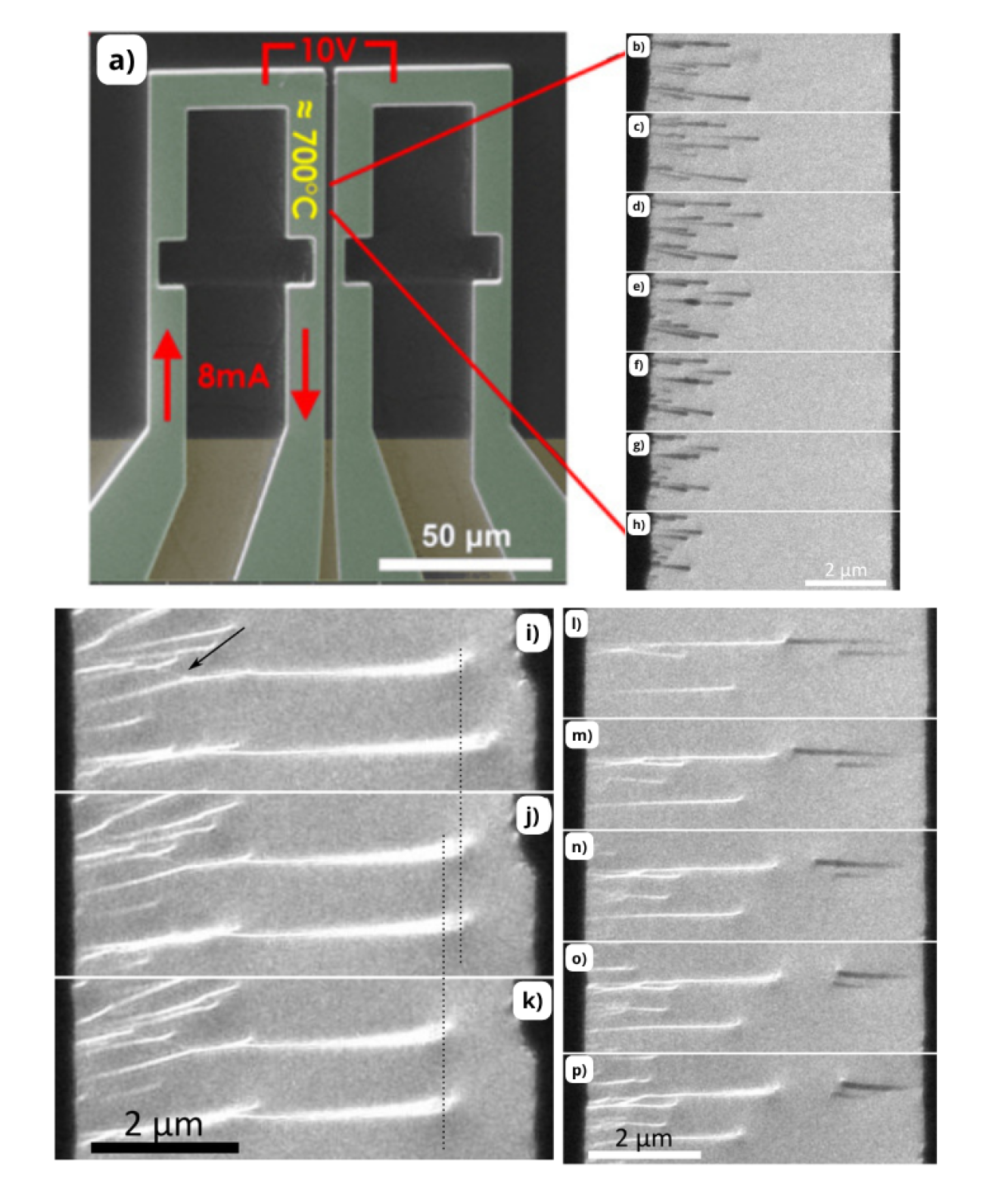
Figure. Experimental setup and polarity-dependent evolution of SWNTs during in situ EFDS and FE experiments in an environmental TEM.
(a) SEM image of the active zone of the micromachined chip heater, which incorporates two facing silicon cantilevers. One cantilever is Joule-heated, while a polarization voltage is applied between them. CNT growth and evaporation are observed across the gap, where the electric field is highest. (b–h) Images recorded under negative polarity. As the applied voltage increases, several nanotubes progressively evaporate from their apex, while others are abruptly torn from the catalyst. (i–k) Example of positive polarity field evaporation. (i) Initial state before evaporation. (j) A shortening of the longest nanotube is observed. (k) Upon further increasing the voltage, a simultaneous reduction in length of the two longest nanotubes occurs. (l) High-resolution image showing a positive polarity nanotube (bright, connected to the heated growth electrode at ~1000 K) located opposite a nanodart (dark nanotube anchored to the cold electrode at ~300 K), which corresponds to the negative polarity side where field emission is possible. The two fragments initially appear nearly in contact. (m–p) Progressive increase of the voltage under positive polarity. The nanotube on the positive side undergoes gradual evaporation, while the opposite nanotube retains its full length.
Associated projects: ANR SOLITUBE: Dedicated to exploring the growth of single wall carbon nanotubes under electric field.